1500, After a century under Burgundian rule, the low countries had become the political and economic centre of Northern Europe, with major trade hubs which included Brussels, Tournai, Ghent, Louvain and Bruges. After the area passed under Habsburg control, this trade centre shifted to Antwerp, which in turn became one of Europe's largest financial and international trading zones. The city's artists benefitted greatly from this, joining the Guild of Saint Luke, now known as ‘the Antwerp School’. This produced some of the greatest artists of the time, even if their individual identities are not remembered, as in the following devotional panel. (Fig. 1)
-
-
Outbreak of the Eighty Years' War
-
The Netherlands, led by William I of Orange, revolted against Philip II of Spain due to high taxes, persecution of Protestants by the government, and Philip's efforts to modernize and centralize the devolved-medieval government structures of the provinces. This was the start of the Eighty Years' War, which split the Low Countries in two.
The last quarter of the 16th century was marked by Calvinist Iconoclastic riots across the Low Countries (Beeldenstorm). This importantly lead to a decrease in commissions for religious subjects, and the rise of secular art embracing the Protestant values in the reformed areas. The young Abraham Bloemaert followed this trend, demonstrated by his sketch of "The Killing of the Niobids" (Fig. 3). He became a leading figure of the Haarlem Mannerists. -
-
Artistic exchanges with Italy
-
The 16th century was marked by strong artistic exchanges between Italy and the Low Countries, as a result of many discoveries made in Rome, also enhanced by the widespread dissemination of prints. Whilst there is no evidence Jacob de Backer (Fig. 4) travelled to Italy, the many stylistic references to late central Italian mannerism in his work suggest he drew inspiration from Italian models. Sustris (Fig. 5) and de Witte (Fig. 6), however, did travel and work extensively in the country. This had a strong impact upon their work, which was admired by patrons all around Europe.
-
THE COUNTER-REFORMATION
At the dawn of the 17th century, the Catholic Church sought its revival, making use of the talented Peter Paul Rubens, who had just returned from Italy. Setting up his workshop in Antwerp in 1609 to fulfil his courtly orders, Rubens immensely broadened the city's artistic scene, becoming the catalyst for the Northern Baroque era.
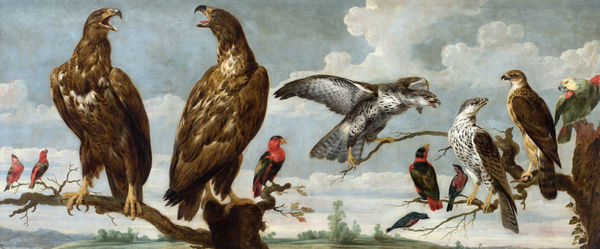
Amongst his most talented pupils, the young Anthony van Dyck assisted him for important commissions, such as the Penitent Saint Peter (Fig. 7) executed in Rubens' workshop at the age of 19. Rubens would also collaborate with other talented artists in Antwerp, such as Paul de Vos (Fig. 8) and Frans Snyders, whose talent for animal paintings made them sought after. Peter Thijs (Fig. 9) formed the next generation of painters in the city. However, with the teachings of van Dyck, he kept the Flemish baroque legacy alive.
-
The Peace of Munster
By the end of the Eighty Years' War, Antwerp's trading activities were weakened. This fall benefitted the Dutch cities of Amsterdam, Utrecht and Haarlem, which became major artistic zones themselves. Willem Claesz Heda (Fig. 10) and Govaert Flinck (Fig. 11) represent the golden age of painting, where immense wealth contributed to the creation of the most prolific art scene in history.
-
The Disaster year
The Dutch Republic, however, did not see Louis XIV's ambitions coming. The outbreak of the Franco-Dutch war put a sharp end to the Dutch Golden Age, and the art scene it spawned would sadly disappear too.
-
HENDRICK VAN MINDERHOUT (Rotterdam, 1632 - Antwerp, 1696) & JAN VAN HELMONT (Antwerp, 1650 - Brussels, 1714)
The Arrival at St. Anneke in Antwerp, with a noble family, presumably the Arenberg-Croÿ Family in the Foreground (1692)